The container is the first brick in a hyperscaler
The Interior Department just signed the first-ever tribal energy agreement. Here is why a single container on sovereign land changes what a hyperscaler can be.
The Interior Department signed the nation’s first-ever tribal energy agreement this week. Read that sentence slowly. The first. Ever.
Not the first this decade. The first in the history of the United States government’s relationship with tribal nations.
That is the door. Here is the room.
What a hyperscaler actually is
AWS did not start as a hyperscaler. It started as a way to stop rebuilding the same server rack for every internal project at Amazon. One rack. One abstraction. Then another team used it. Then an outside company. Then ten thousand outside companies. The hyperscaler grew by replication, not by one enormous bet.
The word hyperscaler makes people think of campuses in Virginia with enough power draw to light a mid-size city. That is what replication looks like at year twenty. It is not what it looks like at year one.
At year one, it is a box.
The box we are building
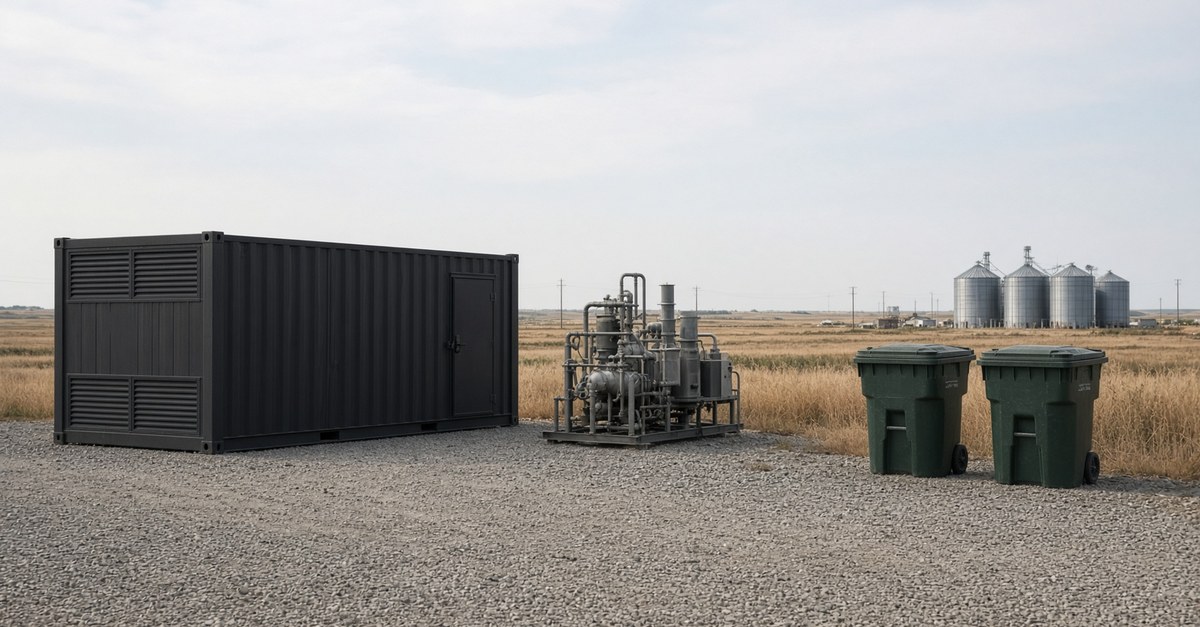
Our Phase 2 node is a containerized unit. Native-owned waste-to-energy conversion drives the power. Thermochemical processing of municipal solid waste produces the electricity. Thermal exhaust drives absorption cooling, so the cooling is free. Multi-stage distillation converts wastewater to potable water, so the water is free. Energy input: permanent. The feedstock is municipal solid waste. It is not going anywhere.
Inside that container sits our compute layer: 128 NVIDIA H100 GPUs for high-end inference, 400 L40S GPUs for production inference at scale, roughly 400 kW of usable IT power. The Sovereign Shield software stack runs on top. The Sovereign Health LLM, fine-tuned at 97.78 percent accuracy on 41,000+ training pairs, runs inside that box. Raw patient health information never leaves the local node. The community holds the keys. Literally.
One node. $3.8M to $5.0M in projected annual revenue. A payback period of two to four years.
That is a brick.
Why the Interior agreement matters for this
Energy is always the first fight. Before you can place a node, you have to answer the power question. Tribal nations have historically had to route energy development through state public utility commissions and federal permitting structures that treat sovereign land like it is just another county. That created a predevelopment gap. Projects stall before a shovel touches the ground because the energy agreements required to finance them do not exist yet.
The Interior agreement this week starts to close that gap at the federal level. It establishes that the United States government can enter a direct energy agreement with a tribal nation, treating the nation as the sovereign counterparty it legally is. That is a precedent. Precedents are infrastructure.
For us, that matters because the closed-loop waste-to-energy architecture we are building sidesteps the grid almost entirely. The node generates its own power. But permitting, land use, and trust land status still move through federal channels. A federal government willing to sign a first-ever agreement is a federal government that has acknowledged, at least once, that sovereign energy is a real category. That acknowledgment has value.
The crumb theory of infrastructure
People underestimate small starts because they are measuring against the end state of someone else’s build. They see AWS and assume you need a campus. They see Walmart and assume you need a thousand stores. They see a hyperscaler and assume you need a continent.
You need one node that works. Then one more. Then a third in a different nation. Then a federated model trained on data from all three that no single node could have built alone. Each node becomes the most knowledgeable AI system in the world about its specific community, because the data never left and the model kept learning.
That is not a diminished version of what a hyperscaler does. That is the architecture the next one is built on.
Pick up enough crumbs, you get a loaf of bread.
What AILT has to do with this
Adaptive Inclusive Leadership Theory is the governance layer sitting under the compute layer. Most infrastructure builds treat governance as a compliance checkbox: get the legal sign-off and move on. AILT treats it as architecture. The question is not just who owns the box. The question is who holds the keys to the model, who can audit what it learned, who can tell it to forget something, and what happens when the community’s values and the optimization target of the AI are not the same thing.
At the hyperscale end of this build, that governance architecture is what makes one nation trust us over a vendor who can offer cheaper compute. Sovereignty is not a feature. It is the structure. You cannot bolt it on after the fact.
The Interior agreement is a brick. The container is a brick. The governance framework is a brick.
Building the next hyperscaler one node at a time.
Get the journal by email
One email when there is an entry. Nothing else. No pitch. Unsubscribe whenever you want.