Readers told the industry: ask us first
Native News Online readers want tribal say over data centers on their land. That demand is the architecture Sovereign Shield is already building toward.
Native News Online ran a reader poll this week. The results were not close. Readers opposed data centers near tribal communities and demanded tribal say over what gets built on their land.
That is not a protest. That is a procurement requirement.
The industry hears that as friction. I hear it as a spec.
The problem with someone else’s rack
When a hyperscaler proposes a data center near tribal land, the pitch usually goes like this: jobs, tax base, economic development. The fine print is less pretty. The data that flows through that facility answers to the company that owns the rack. The tribe gets proximity, not sovereignty.
Data localization is not just a privacy preference. It is a governance position. What a community can and cannot ask an AI system, who can audit the answers, who holds the encryption keys, those are constitutional questions dressed in a technical uniform.
The readers at Native News Online already understand this. They are not anti-technology. They are pro-control. That is a distinction the hyperscalers keep misreading.
One container is not a consolation prize
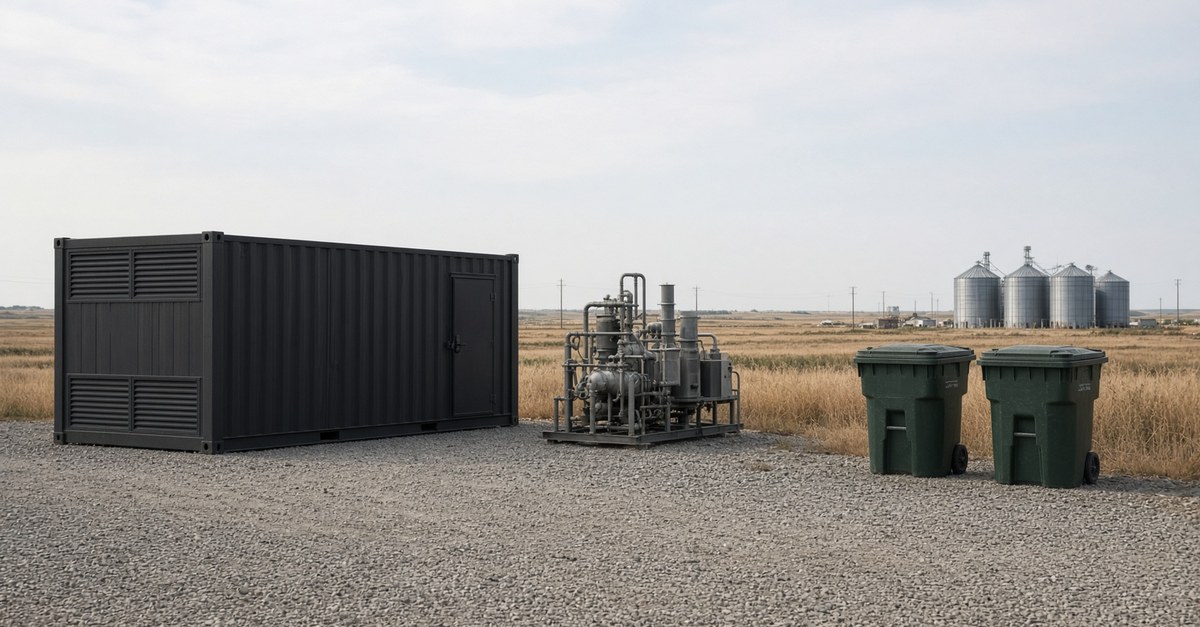
Sovereign Shield starts with a single containerized node on tribal land. Not a campus. Not a co-location deal. One container.
Inside that container: a closed-loop waste-to-energy system converting municipal solid waste into electricity. The thermal exhaust drives absorption cooling. Wastewater runs through multi-stage distillation and comes back potable. Energy cost: zero. Cooling cost: zero. Municipal water draw: zero.
The compute layer sits inside that same footprint. The software layer carries the Sovereign Prompt Shield architecture. AES-256-GCM encryption runs client-side before any AI processing touches the data. Raw PHI never leaves the local node. The community holds the keys.
One node can generate between $3.8M and $5.0M in annual revenue at conservative utilization rates. Payback is two to four years. That is the economics of a casino, not a charity.
And unlike a casino, the asset appreciates as the model learns. Each node trains on its own community’s data. Federated learning pushes those updates to a central foundation model. The node gets smarter about the people it serves every day it operates. After three years, that node knows more about health outcomes in its specific tribal community than any outside system ever could. That knowledge does not belong to a hyperscaler in Virginia. It belongs to the nation.
What the hyperscalers cannot buy
Amazon can drop a data center on any patch of land with good fiber and power. What it cannot do is walk into a tribal council and say the facility is Native-owned, that the company operating it holds tribal citizenship, and that the governance framework was built from Indigenous leadership theory, not from a consulting slide deck.
Both Sovereign Shield and our infrastructure partner hold tribal citizenship. Chickasaw on the software side. Cherokee on the hardware side. Nation-to-nation data agreements, federal trust responsibility pathways, sovereign procurement preferences. Those advantages do not transfer. They are not assets a larger company can acquire by writing a check.
The readers at Native News Online are drawing that line themselves. The industry can treat that line as an obstacle or as a signal. We built Sovereign Shield because we read it as a signal three years before the poll was published.
AILT and the governance layer
Adaptive Inclusive Leadership Theory is the framework I am developing through my doctoral work. The short version: inclusion is not a value you bolt onto a system after it is built. It is a design parameter you set before the first line of code or the first concrete pour.
A node with community-held encryption keys is an AILT artifact. Append-only audit logs that a tribal council can read are an AILT artifact. A health LLM fine-tuned on 41,000+ training pairs from populations that commercial models were never trained on is an AILT artifact.
Governance is not the ribbon on the package. Governance is the load-bearing wall.
When Native News Online readers say they want tribal say, they are describing a governance requirement. The question for any builder is whether the architecture was designed to satisfy that requirement or designed to negotiate around it.
The crumbs
One node on tribal land in Oklahoma. Then a second. Then a third at an FQHC in a rural county with no hospital closer than forty miles. Then a fifth at a tribal school system that wants its students’ data to stay on the reservation.
The hyperscalers are building gigawatt campuses. We are building a distributed network of sovereign nodes, each one governed by the community it serves, each one financially viable on its own terms.
Pick up enough crumbs, you get a loaf of bread.
The readers already know what they want. The only question is who shows up with the right architecture.
Get the journal by email
One email when there is an entry. Nothing else. No pitch. Unsubscribe whenever you want.