The Department of Energy just handed tribes a blueprint
The DOE mapped tribal data center economics. Here is what the map does not show you about building a sovereign hyperscaler one node at a time.
The Department of Energy published a report this week on harnessing data centers for tribal economic development. That is a sentence I would not have been able to type two years ago without it sounding like a pitch for something that did not exist yet.
It exists now. The question is who builds it, and how.
What the DOE got right
The report names the same things we have been naming from Ada: tribes have land, tribes have energy rights, tribes have sovereign procurement authority, and most tribes have none of the compute infrastructure that increasingly runs the American economy. The gap is structural, not incidental.
A data center on tribal land is not just an economic development project. It is a governance decision. Whoever owns the compute layer owns the inference layer. Whoever owns the inference layer shapes what the community knows about itself, how its health data is processed, how its language is preserved or lost, how its children are educated. The DOE report is useful because it quantifies opportunity. It is incomplete because it does not say anything about who holds the keys.
What a single container actually is
Here is the physical reality behind the manifesto headline: Building the Next Hyperscaler One Node at a Time.
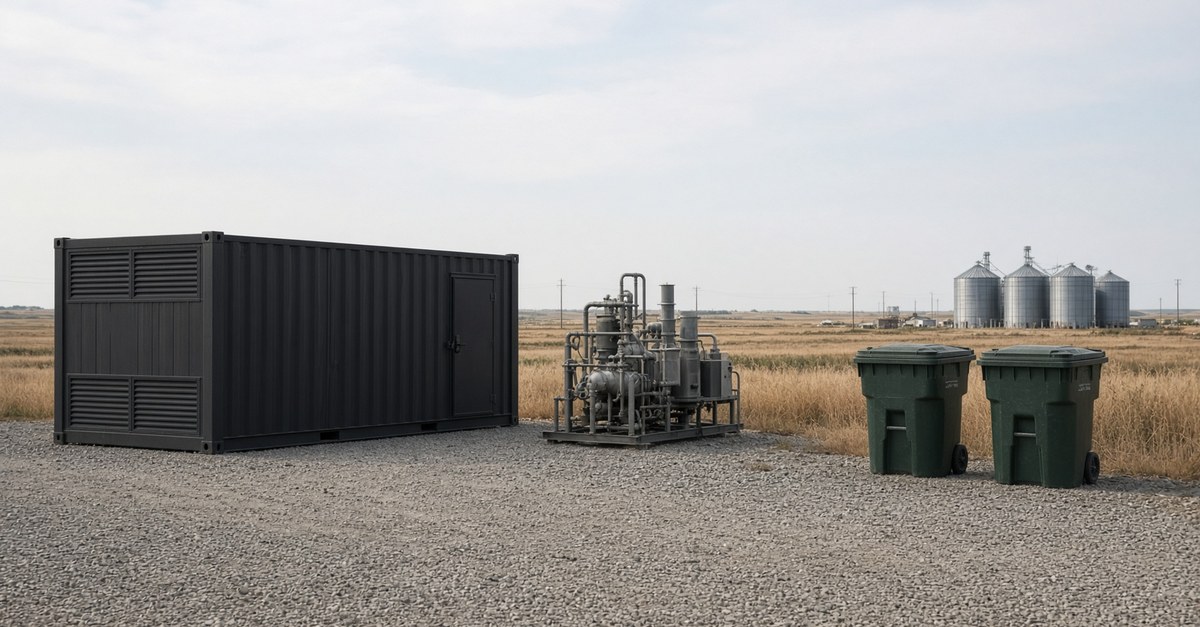
A single containerized unit. Thermochemical conversion of municipal solid waste, used tires, oil field byproduct. Clean electricity out. Thermal exhaust drives absorption cooling. Wastewater distillation converts runoff to potable water. Net electrical output around 500 kilowatts, with roughly 400 kilowatts available for IT load after losses.
Inside that load: enough GPU capacity for real inference at scale. Not a prototype. A working node.
Energy cost: zero. Cooling cost: zero. Municipal water cost: zero. The feedstock is the waste stream that tribal land management is already dealing with. The economics flip completely. You are not paying a utility. You are processing a liability and turning it into compute.
That is the architecture. Copious Specialties, Cherokee-owned, holds the hardware engineering. Sovereign Shield Technologies, Chickasaw-owned, holds the software stack. Nation-to-nation. No outside energy company in the loop.
The crumb-to-loaf logic
Hyperscalers did not start as hyperscalers. They started as one rack, one building, one region. The scale came from replication, not from a single capital event.
The sovereign version of that story starts with one container on one tribe’s land. It generates revenue: GPU cloud leasing, application licensing, carbon credits, waste processing fees. Conservative projections on a single node sit between $3.8 million and $5 million annually. The payback window on capital runs two to four years. After payback, the node is an asset the community owns outright.
Node two goes to the next tribe, or the next federally qualified health center, or the next rural county that has been waiting years for broadband-adjacent infrastructure that a cloud provider has no financial reason to build.
Pick up enough crumbs, you get a loaf of bread.
What the DOE blueprint cannot hand you
The report is a door. The room is harder.
A tribal nation that signs a data center agreement with a non-Native operator has traded its sovereignty for a lease payment. The data still leaves. The inference still happens somewhere else. The keys still belong to someone in a city that has never heard of Ada, Oklahoma.
The moat we are building is not technical. Any well-capitalized team can replicate GPU infrastructure. The moat is structural. Chickasaw citizenship on one side, Cherokee citizenship on the other. Sovereign procurement pathways. Nation-to-nation data agreements that no outside company can execute because they require a sovereignty that is not for sale and not for lease.
The DOE just told every tribe in the country that the opportunity is real. That is genuinely useful. What it cannot hand you is the ownership structure that makes the opportunity serve the community rather than extract from it.
What one node teaches
I keep coming back to this: the fine-tuned Sovereign Health LLM running on 41,000+ training pairs does not get smarter from a data center in Virginia. It gets smarter from data that stays local, trains locally, and federates back to the foundation model without raw patient health information ever leaving the node.
Each node becomes the most knowledgeable AI in the world about its specific community. That is not a marketing claim. That is what federated learning produces when the data has nowhere else to go.
The DOE can write the blueprint. The blueprint is not the building. We are in Ada, building the building.
Get the journal by email
One email when there is an entry. Nothing else. No pitch. Unsubscribe whenever you want.