The Cheyenne and Arapaho said no to the data center
A tribe just blocked a data center. That vote is not a wall. It is a map of what sovereign infrastructure has to be.
The Cheyenne and Arapaho Tribe approved a moratorium on data centers in Oklahoma. Not a pause. A moratorium. That word has weight.
Read it one way and it looks like a door closing. Read it the way I read it from Ada, and it looks like a community drawing a line around what it will and will not accept on its land.
That is not a problem to solve. That is a requirement to meet.
The standard model fails the test
A hyperscaler shows up with a proposal. Hundreds of megawatts. Municipal water by the millions of gallons. Diesel backup generators idling. Jobs that mostly don’t go to tribal members. Data that flows out of the community and into someone else’s cloud. Revenue that goes to shareholders in Virginia or Seattle.
The tribe votes no. Of course it does.
The moratorium is not anti-technology. It is anti-extraction. Those are different things, and most of the people writing about this story are not making the distinction.
What the node changes
The architecture I am building starts from the opposite direction.
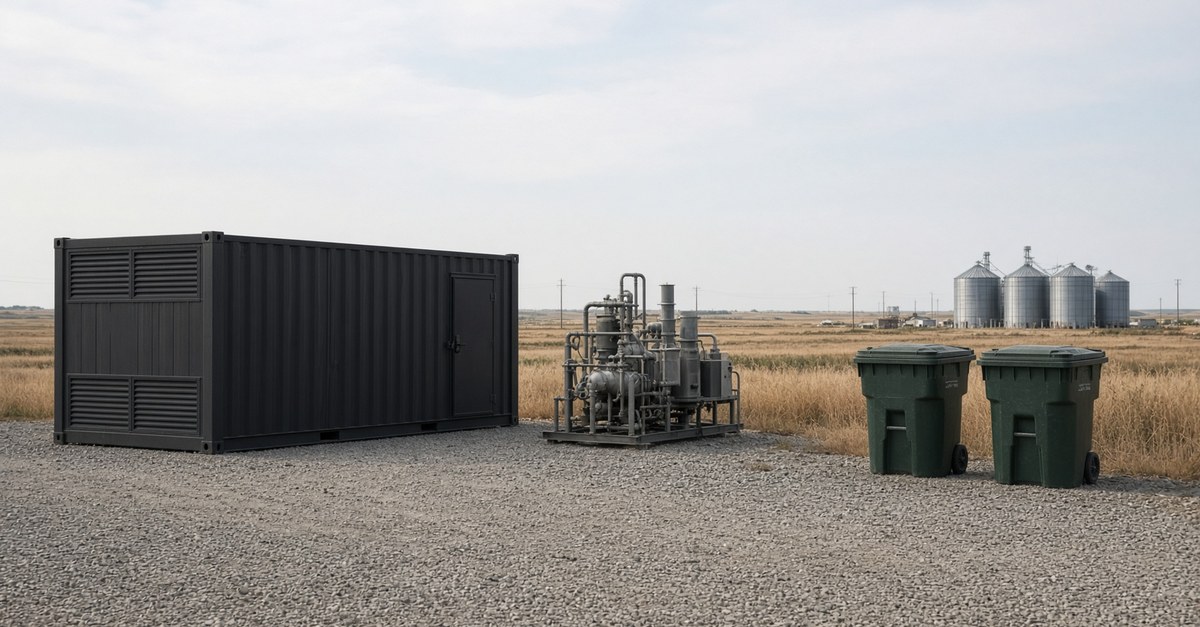
A single containerized unit. Native-owned waste-to-energy inside the same footprint. Thermochemical conversion of municipal solid waste, used tires, oil, metals into clean electricity. Thermal exhaust drives absorption cooling. Multi-stage distillation converts wastewater to potable. The unit does not draw from the municipal grid. It does not drain the aquifer. It processes what the community was already paying to haul away.
The compute sits inside that same container. GPU inference load matched to available power. The Sovereign Prompt Shield architecture means raw patient health information, raw community data, never leaves the node. AES-256-GCM encryption on device before any AI processing. Append-only audit logs. The community holds the keys.
That is not a pitch. That is the design constraint. The constraint came first.
A hyperscaler takes water and gives you a cloud bill. This node takes waste and gives the community a data center it owns.
Why one node is enough to start
Building the next hyperscaler one node at a time is the manifesto headline. It is also the literal strategy. Pick up enough crumbs, you get a loaf of bread.
One node is not symbolic. One node generates real infrastructure, real compute, real revenue. The Sovereign Health LLM is already fine-tuned at 97.78 percent accuracy on 41,000+ training pairs. That model runs locally. Each deployed node becomes, over time, the most knowledgeable AI system in the world about its specific community, because its training data never leaves.
Federated learning across nodes feeds a central foundation model. The network gets smarter together without pooling data centrally. The community does not have to choose between intelligence and privacy.
AILT is the governance layer, not the branding
Adaptive Inclusive Leadership Theory is the framework I have been building through doctoral research. The three-layer architecture of Sovereign Shield puts AILT at the top: governance first, infrastructure second, product third.
Most technology deployments invert that stack. They build the product, figure out the infrastructure, and call the governance layer a terms of service update.
The Cheyenne and Arapaho moratorium is what happens when communities encounter the inverted stack long enough. They stop trusting the category entirely. You cannot blame them.
AILT applied to sovereign infrastructure means the governance decisions, who holds the keys, who sits in the procurement room, who controls the audit logs, come before the first container is dropped on the land. Not as a formality. As the structural requirement that shapes everything beneath it.
A leader building in sovereign and rural communities right now needs to understand this: the communities that are saying no to standard data centers are not behind. They are ahead. They already know what extractive infrastructure costs, because they have been paying that cost for a long time.
The map the moratorium draws
I am not building for the communities that will take any data center. I am building for the ones that will not. That is the market the standard hyperscaler cannot reach, because the standard hyperscaler cannot meet the requirement.
One container. One community. Native-owned energy. Community-held keys. That is the first node.
The second one follows. Then the third. That is how a hyperscaler gets built from Ada, Oklahoma.
Yakoke.
Get the journal by email
One email when there is an entry. Nothing else. No pitch. Unsubscribe whenever you want.