Federal dollars just reached a Juneau utility. A node follows.
The DOE just sent $125M to 63 tribal energy projects. What that money is really buying is the right to build infrastructure that answers to no one but the nation.
The Department of Energy just committed more than $125 million across 63 tribal energy projects in 16 states. A Juneau-based utility made the list. So did Chugachmiut in Alaska. The money is real. The signal behind it is worth reading carefully.
Federal energy funding to tribal nations is not new. What is new is the scale and the timing. Data centers are now the single largest growth driver of electricity demand in the United States. The grid conversation and the sovereignty conversation are converging at the same moment. That convergence is not an accident. It is an opening.
What a node actually is
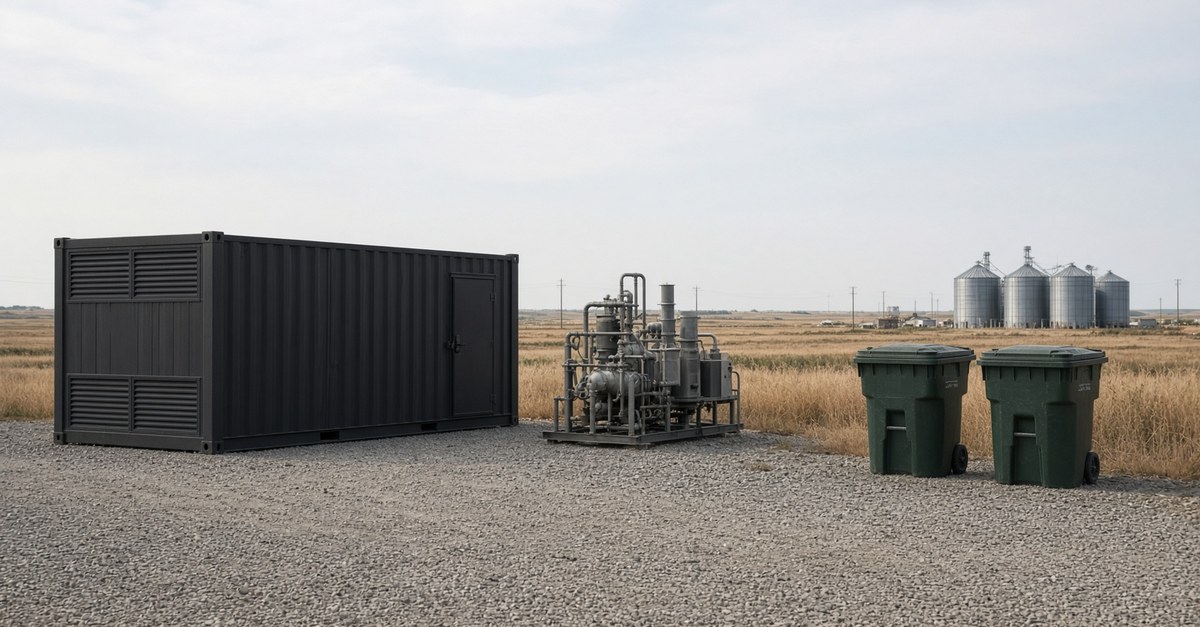
When I say node, I do not mean a server in a leased rack somewhere off-reservation. I mean a containerized unit: compute, cooling, and power generation in one closed loop, placed on tribal land, owned by the nation.
The compute side runs GPU inference at scale. The power side converts municipal solid waste, used tires, and similar feedstock into clean electricity through thermochemical conversion. Thermal exhaust drives absorption cooling. A distillation stage turns wastewater into potable water. The container pays for its own cooling. It pays for its own water. It produces electricity it does not have to buy.
One container. One nation. One closed loop.
That is what the DOE funding makes structurally possible at a wider scale. Nations that control their own energy infrastructure can host their own compute. Nations that host their own compute do not have to route their citizens’ health data through a cloud in Virginia.
The crumbs that become a loaf
The Sovereign Shield thesis is not a stadium bet. It is a crumb-by-crumb build. A single node, conservatively sized, covers its capital cost in two to four years. The operating cost floor is nearly zero because energy, cooling, and water are closed-loop. Each additional node added to the network feeds a central foundation model with federated data that never left the community. The model gets smarter about that community without the data ever moving.
That is the point that most outside developers miss when they look at tribal markets: they see fragmentation. They see small populations dispersed across large geographies with thin margins. They see a market that does not pencil.
What they do not see is that the fragmentation is the moat. A node built for one nation becomes the most contextually knowledgeable AI system in the world about that one nation. Thirty nations. Thirty nodes. Thirty data moats that federate into a foundation model no hyperscaler can replicate because no hyperscaler has the trust agreements, the citizenship, or the geographic footprint to get the data in the first place.
The Sovereign Health LLM is already trained on 41,000+ training pairs. It scores 97.78 percent on benchmarks. It runs HIPAA-aligned with AES-256-GCM encryption on-device. Raw PHI never leaves the local node. That is not aspirational language. That is current architecture.
What the DOE signal actually teaches
The federal government just confirmed what the thesis requires: tribal nations can own and operate energy infrastructure at a scale that supports modern compute loads. That removes the single most common objection from skeptics who hear the node concept and ask where the power comes from.
The power comes from the same place the nation’s waste goes. It comes from a closed loop that turns a liability into an asset. It comes from the same sovereignty that the DOE just spent $125 million validating.
European banks are reportedly hesitant about sovereign AI readiness, according to Reuters this week. The Gulf region is negotiating between data sovereignty and accessibility. The debate is global and it is unresolved. The nations and communities building their own infrastructure now will not be waiting on that resolution. They will already be running.
The leadership layer underneath
AILT, Adaptive Inclusive Leadership Theory, frames this as a governance question before it is a technology question. You cannot drop a node into a nation and declare it sovereign infrastructure. The governance layer has to exist first. Data agreements. Community consent frameworks. Nation-to-nation compact structures that define who holds the keys to the model, who can query the audit log, and what happens when a federal agency asks for access.
The technical architecture enforces those answers. But the answers have to come from the nation. That is the leadership work. That is what distinguishes a sovereign node from a server that happens to sit on tribal land.
Pick up enough crumbs, you get a loaf of bread. The DOE just confirmed that the crumbs are there.
Yakoke.
Get the journal by email
One email when there is an entry. Nothing else. No pitch. Unsubscribe whenever you want.