Bloomberg noticed the playbook tribal nations wrote first
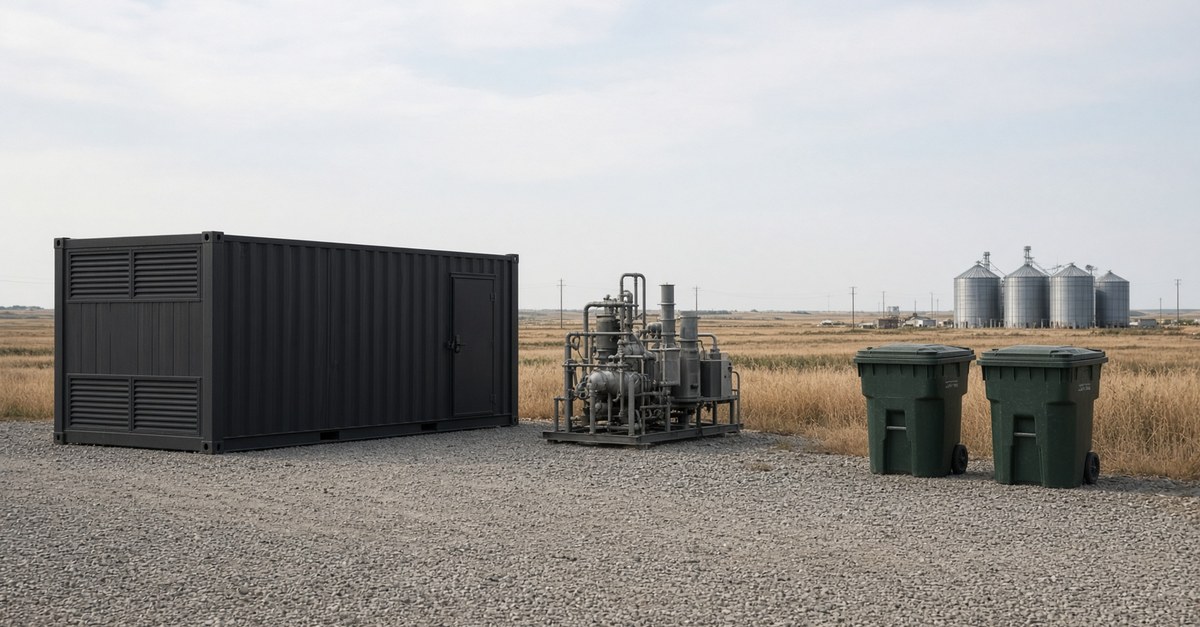
A single container on tribal land is not a pilot. It is the first repeat of a pattern that scales to a hyperscaler.
Bloomberg Law News ran a piece this week on AI data center deals on tribal lands writing a new playbook. The headline is right. The framing is backwards.
Tribal nations did not discover a playbook when hyperscalers came calling. They have always known what their land, their sovereignty, and their governance structures can do. What changed is that a $500 billion compute shortage made the rest of the market notice.
I am not interested in being noticed. I am interested in being ready when the second call comes.
What one node actually is
People hear “one container” and think small. They should think repeatable.
A single closed-loop node on tribal land runs on thermochemical conversion of municipal solid waste. The electrical output powers GPU compute. The thermal exhaust drives absorption cooling. A multi-stage distillation loop turns wastewater into potable water. Energy cost: zero. Cooling cost: zero. Water cost: zero or net-positive.
That is not a pilot. That is a unit of production.
The Crusoe Energy thesis proved the category. Waste feedstock plus colocated compute. Their feedstock was stranded natural gas. Ours is municipal solid waste, which is structurally permanent. Every community generates it. Nobody is running out of tires, used oil, or solid waste. The feedstock is the cheapest durable input in infrastructure history.
Now add sovereign positioning. Both companies in our partnership are Native-owned and Indigenous-led. That is not a branding choice. It is a structural moat that no outside competitor can acquire. Tribal procurement pathways, nation-to-nation data agreements, federal trust responsibility. Those are not features. They are the room itself, and the door has no outside handle.
The thing Bloomberg did not say
The Bloomberg story is about deals. Land agreements, utility interconnects, megawatt headlines. That is the infrastructure layer.
What the story cannot see yet is the software layer sitting inside the container.
Our Sovereign Health LLM is fine-tuned at 97.78 percent accuracy on 41,000+ training pairs. It runs HIPAA-aligned, client-side, with AES-256-GCM encryption before any AI processing touches the data. Raw protected health information never crosses a wire to a distant cloud. It stays in the node. The node sits on the nation’s land. The nation holds the keys.
Each node learns about its specific community. A node deployed to an FQHC in rural Oklahoma learns the disease burden, the social determinants, the language, the trust patterns of that patient population. Federated learning across nodes feeds one central foundation model without centralizing the data. Over time, each node becomes the most knowledgeable AI in the world about its own community.
That is what a hyperscaler looks like from the inside of a sovereign community. Not a warehouse in northern Virginia. A container on the land. Owned. Governed. Learning.
What AILT has to do with it
Adaptive Inclusive Leadership Theory sits at the governance layer of this architecture, not as a philosophy posted on a wall but as a structural decision about who holds power over the system.
AILT starts from the premise that the people closest to a problem carry knowledge that no outside expert can replicate. In infrastructure terms, that means the tribal council, the clinic administrator, the community health worker know things about their population that a hyperscaler in Seattle will never learn from usage logs.
The framework asks leaders to do three things. Widen the decision circle before the system is built. Hold the structure adaptive so it can change when the community changes. And name the costs honestly, not smooth them over.
Applied to a sovereign node, that means: governance documents before code. Data sovereignty agreements before equipment delivery. Community consent before the first inference call. The node is not infrastructure dropped onto a community. It is infrastructure built from within one.
That is why the governance layer sits under the racks, not above them. By the time the hardware arrives, the decision-making structure already exists.
One crumb at a time
Bloomberg will keep covering the big deals. The gigawatt announcements, the hyperscaler land rushes, the Senate bills that hit snags over utility costs.
I am watching a different number. How many nodes can we repeat before the market understands what repeatable actually means at scale.
One container is not a company. Ten containers across sovereign and rural communities, each one owned, each one learning, each one feeding a shared model while keeping its community’s data local, that starts to look like something the market has never seen before.
Pick up enough crumbs, you get a loaf of bread.
We are in the crumb phase. I know exactly what we are building.
Get the journal by email
One email when there is an entry. Nothing else. No pitch. Unsubscribe whenever you want.