One container is a hyperscaler if you can repeat it
The next hyperscaler is not a campus you announce. It is a node you can stand up on land the community already holds.
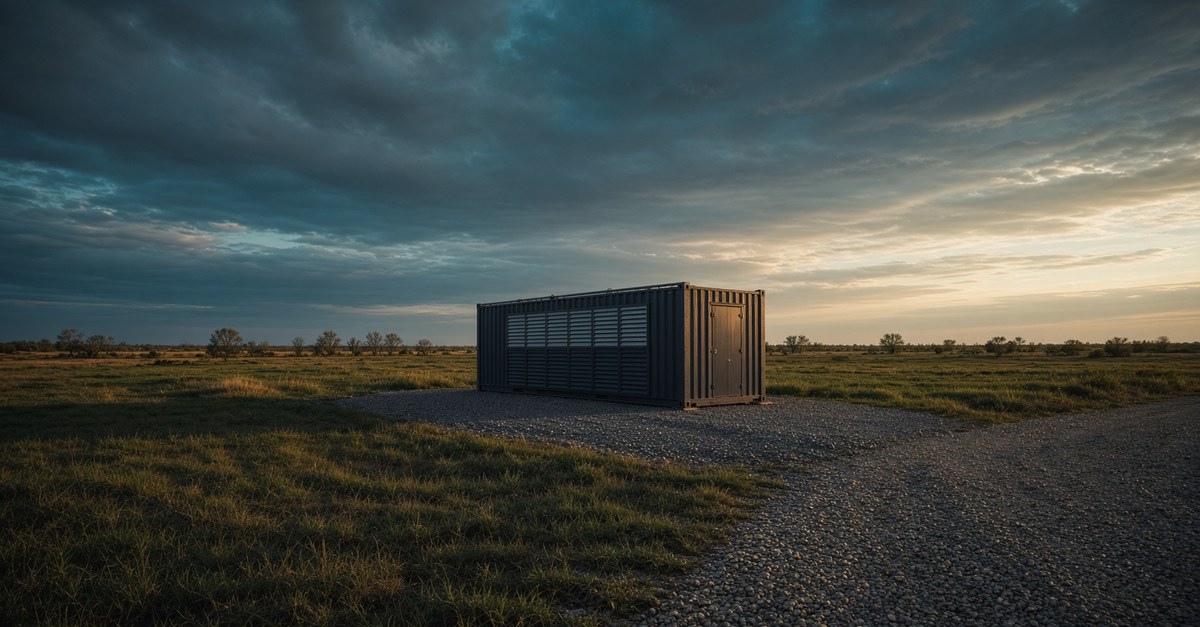
People hear hyperscaler and picture a campus on the edge of a city, a ribbon cutting, a number in gigawatts. That picture is someone else’s business. Mine is a container.
The manifesto line is not poetry. Building the next hyperscaler one node at a time is an operating constraint. A node has to be small enough to site on land a nation already holds. It has to make its own power, or it will spend the next decade arguing with a utility. It has to cool itself from what it already burns, or it will spend the decade after that arguing about water. And the software that runs on it has to belong to the people whose data it touches.
That is the closed loop, stated without a pitch deck.
Energy first. A Native-owned waste-to-energy partner converts municipal solid waste, used tires, oil, and metals into electricity. Thermal exhaust drives absorption cooling. Multi-stage distillation takes wastewater and returns potable water. Energy, cooling, and water are not line items you negotiate with a distant provider. They are outputs of the same machine. The compute load is sized to what that machine actually produces. Not to a nameplate fantasy.
Then the software. The model does not live in a region you selected from a dropdown. It lives in the node. Raw PHI never leaves. Federated learning can move what the model learned, not what the patient said. Each node becomes the most knowledgeable system in the world about its own community, which is the opposite of the usual cloud promise. The usual cloud promise is that a model trained on everyone will be good enough for you. We are building the other way.
I am writing this from Ada, Oklahoma, on Chickasaw land. The first node belongs here, or in Tishomingo, or with a neighbor nation that asks. Rural is not a constraint we are trying to escape. It is the market. Sovereign and rural communities are the whole point. The people who tell you that density is efficiency have not priced what it costs a clinic in this county to send a record to a region it does not control.
There is a cost to starting with one. You do not get the theater of a campus. You do not get to say you are at national scale on day one. You get a box, a power plant the size of a claim, and a software stack that has to work for a real FQHC with a real Tuesday. If that node fails, there is no press cycle to hide in. The people who trusted you still live here.
That cost is the filter. A design that only works at fifty nodes is a design that will never be honest at one. A design that works at one, with the keys in the community’s hands, can be copied. Copying is the hyperscaler. Not the announcement.
I think about Crusoe sometimes, because they proved that waste energy plus colocated compute is not a thought experiment. They also proved it inside a category that still depends on someone else’s feedstock geography. Our feedstock is municipal. It shows up wherever people live. That is a different map.
Pick up enough crumbs, you get a loaf of bread. The crumbs are nodes. The loaf is a network a nation can point to and say, that is ours. Not a region. Not a credit. Ours.
The temptation, always, is to skip the first container and design the hundredth. I have that temptation. The theory tells me what it costs. Inclusive Adaptive Capacity does not survive a plan that only works after you are already too big to listen. So we build the one we can stand in. Then we build the next.